


Exam season doesn’t arrive overnight — but it can feel that way. One week your child seems to be coasting through the semester, and the next they’re facing a wall of AP exams, final tests, state assessments, and end-of-year projects all converging at once.
For parents, this stretch from late March through June is one of the most critical windows of the academic year. It’s when semester grades are finalized, when standardized test scores are locked in, and when the study habits your child has (or hasn’t) built all year are put to the test. It’s also when stress levels peak — for students and the parents watching from the sidelines.
The good news is that you don’t need to become your child’s tutor, drill sergeant, or personal assistant to make a meaningful difference. What students need most from their parents during exam season is structure, calm, and the right tools to stay organized. This guide will walk you through exactly how to provide all three.
Why Exam Season Is Different From the Rest of the Year
During the regular school year, your child manages a relatively predictable rhythm: classes, homework, the occasional quiz. Exam season breaks that rhythm. Suddenly, multiple high-stakes assessments are stacked into a compressed timeframe, each covering months of material.
For students taking AP exams, the window is particularly intense. The 2026 AP Exams run from May 4–8 and May 11–15, which means a student taking three or four AP classes could face back-to-back exams with almost no recovery time between them. State standardized tests often land in a similar window, and end-of-year finals follow shortly after.
This compression is what makes exam season fundamentally different from day-to-day school. It demands a different level of planning, a different approach to studying, and — for many students — a different kind of support from home. If your child has been managing schoolwork week-to-week without much forward planning, now is the moment to shift gears. Our guide to organizing a study schedule covers the fundamentals of that shift.
Step 1: Map Out the Full Exam Calendar Together

The single most valuable thing you can do right now is help your child get every upcoming exam, test, and major deadline into one place. Not scattered across syllabi, not floating in their memory — written down, dated, and visible.
Sit down together and identify every assessment between now and the last day of school. This includes AP exams (the College Board publishes the full schedule months in advance), any state-mandated tests, class finals, and major project due dates. Don’t forget things that aren’t technically exams but compete for the same time and energy — presentations, lab reports, essays, and extracurricular commitments.
A student planner app like MyStudyLife is purpose-built for this. Students can enter each exam with its date, link it to the relevant class, and immediately see where the pressure points are. When your child can visually see that they have an AP History exam on Tuesday and an AP Biology exam on Thursday of the same week, they plan differently. The dashboard view gives them a daily and weekly snapshot of everything ahead — which is exactly what exam season demands.
If you want visibility into that calendar without having to ask your child every evening, MyStudyLife’s Family Connect feature lets you see their exam schedule, upcoming deadlines, and overdue tasks in real time. It’s designed to keep you informed without making your child feel surveilled.
Step 2: Teach Them to Work Backwards From Exam Dates
Once the calendar is built, the next step is the one most students skip entirely: working backwards from each exam to create a realistic study plan.
This is a skill, and most teenagers haven’t been explicitly taught it. The concept is simple but powerful — take the exam date, then count backwards to determine when studying needs to start and what needs to happen each week.
For each major exam, ask these three questions:
- How much material does this exam cover? A full-year final is a fundamentally different beast from a unit test. Help your child estimate the scope honestly.
- How many days before the exam should studying begin? For AP exams and comprehensive finals, two to three weeks of review is a reasonable starting point. For smaller finals, one week may suffice.
- What does each study session need to cover? Break the material into chunks — by unit, chapter, or topic — and assign each chunk to a specific day.
Once those chunks are identified, they go straight into the planner as individual tasks. This transforms “study for AP Chemistry” — which is overwhelming and vague — into “review Unit 3: Thermodynamics on Tuesday” — which is concrete and achievable. MyStudyLife’s task management lets students break larger goals into subtasks with due dates, so nothing slips through the cracks.
The key here is to let your child build the plan. Your role is to ask the right questions and help them think through the logic. The more ownership they have over the schedule, the more likely they are to follow it.
Step 3: Help Them Study Smarter, Not Longer
One of the most common mistakes students make during exam season is confusing time spent studying with effective studying. Re-reading notes for three hours feels productive, but research consistently shows it’s one of the least effective revision strategies.
As a parent, you don’t need to master every study technique — but understanding the basics means you can gently steer your child toward methods that actually work. Harvard Summer School’s guide to test-taking success is an excellent primer for both parents and students looking for an evidence-based starting point.
Active recall is the practice of testing yourself on material rather than passively reviewing it. This could mean using flashcards, answering practice questions, or simply closing the textbook and trying to write down everything they remember about a topic. It’s uncomfortable — which is exactly why it works. The effort of retrieving information strengthens memory far more effectively than re-reading ever will.
Spaced repetition means reviewing material at increasing intervals rather than cramming it all at once. A student who reviews a topic on Monday, again on Wednesday, and once more the following Monday will retain dramatically more than a student who reviews it three times in a single evening. This is where having a planner becomes essential — spacing review sessions out over days and weeks requires a calendar, not willpower.
Practice papers are one of the highest-value study activities for any exam, especially AP tests and state assessments. Working through past papers under timed conditions helps students familiarize themselves with the format, identify weak spots, and build confidence. The College Board provides free AP practice materials including progress checks and full-length practice exams for every subject.
For a deeper dive into specific techniques — from flashcard strategy to color-coded note-taking — our final exam study tips guide covers the methods that research backs and students actually stick with. And for older students heading into university-level exams, the college study tips article goes further into building sustainable study systems.
Step 4: Protect the Basics — Sleep, Food, and Downtime

Exam season has a way of convincing both parents and students that every waking hour should be spent studying. This instinct is understandable but counterproductive.
Sleep is non-negotiable during exam season. The National Sleep Foundation recommends that teenagers get eight to ten hours of sleep per night — yet research shows that nearly 73% of high schoolers fall short of that on school nights. Sleep deprivation directly impairs memory consolidation, the exact brain function students need most during revision. According to the Sleep Foundation’s research on teen sleep, insufficient sleep also increases emotional reactivity, making exam stress significantly harder to regulate. A child who studies until midnight and wakes up at six is actively undermining their own preparation. Help your child set a firm “screens off” time and protect at least eight hours, even during peak exam weeks.
Nutrition matters more than most families realize during high-stress academic periods. The brain consumes roughly 20% of the body’s energy, and that demand increases during sustained cognitive effort. Make sure your child is eating regular, balanced meals — and keep healthy snacks available for study sessions. This isn’t the time for skipped breakfasts or energy-drink-fueled late nights.
Downtime is not a luxury during exam season — it’s a performance strategy. Students who take regular breaks retain more, focus better, and experience less burnout than those who study for hours without pause. The Pomodoro Technique — 25 minutes of focused study followed by a 5-minute break — is a simple framework that works well for most students. MyStudyLife includes a built-in Pomodoro timer that students can use directly within the app to structure their sessions.
Encourage your child to keep at least one non-academic activity going during exam season, whether that’s exercise, time with friends, or a hobby. The goal isn’t to fill every minute with studying — it’s to build a sustainable rhythm that carries them through the entire exam window without crashing.
Step 5: Recognize the Signs of Exam Stress
Some stress during exam season is normal and even beneficial — a moderate level of pressure helps students focus and take preparation seriously. But there’s a threshold beyond which stress becomes destructive, and parents need to know what that looks like.
Watch for these signals:
- Sleep disruption — difficulty falling asleep, waking up in the middle of the night, or sleeping significantly more than usual
- Physical complaints — headaches, stomachaches, or unexplained fatigue that intensifies as exams approach
- Avoidance behavior — suddenly “not caring” about exams, refusing to study, or withdrawing from conversation about school
- Emotional volatility — disproportionate reactions to minor frustrations, tearfulness, or persistent irritability
- Perfectionism spiraling — spending excessive time on a single subject while neglecting others, or expressing that anything less than a perfect score is unacceptable
The American Psychological Association’s research on stress confirms that chronic stress in adolescents can manifest physically long before a student articulates it verbally. If you’re seeing these patterns, the worst thing you can do is add more pressure.
Avoid ultimatums, comparisons to siblings or classmates, and “when I was your age” narratives. Instead, try opening a low-pressure conversation: “You seem like you’re carrying a lot right now. What would help?” Sometimes the answer is a practical solution — help reorganizing the study schedule, a quiet workspace, or permission to drop one extracurricular commitment for a few weeks. Sometimes the answer is simply feeling heard.
If stress symptoms persist or escalate, don’t hesitate to reach out to your child’s school counselor or a mental health professional. Exam anxiety is real, it’s common, and it’s highly treatable with the right support.
Got it — turning Step 6 into the product-led section that positions Family Connect as the answer to the “how do I stay involved without hovering” problem. Here’s the rewrite:
Step 6: Support Without Taking Over — With the Right Tools
This is the hardest part of exam season for most parents, and it’s worth being honest about: your child needs to do this themselves. Your role is to provide the conditions for success — not to do the work for them.
That means resisting the urge to quiz them every evening, check their planner hourly, or rewrite their study schedule when they fall behind. Over-involvement sends an implicit message: “I don’t trust you to handle this.” And during a period when your child’s confidence is already under pressure, that message can do more harm than a missed study session.
The challenge is that stepping back completely doesn’t feel right either — especially when the stakes are high. Most parents aren’t looking to micromanage. They just want to know what’s coming, whether their child is on track, and when to step in versus when to stay quiet.
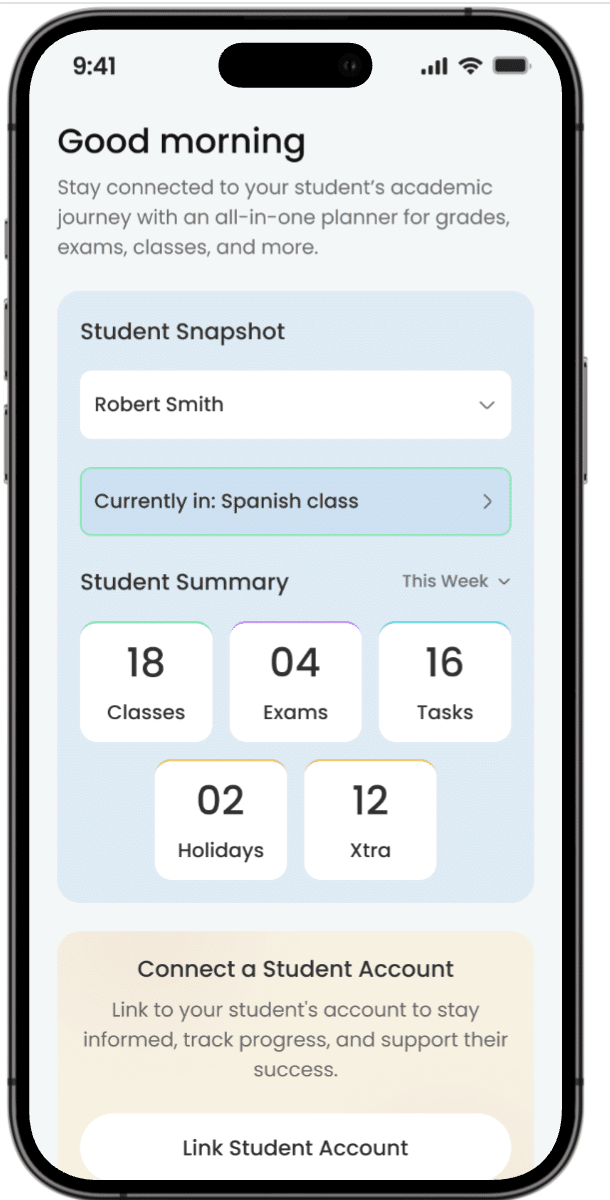
That’s exactly what MyStudyLife’s Family Connect is built for. It’s a companion app that gives parents a clear, real-time view of their child’s academic life — without requiring you to ask a single question.
Here’s what Family Connect gives you during exam season:
- Full visibility of the exam calendar. See every upcoming test, assignment deadline, and class schedule your child has entered — so you know what’s ahead without having to dig through backpacks or send “do you have any tests this week?” texts.
- Overdue task alerts. Get notified when assignments or revision tasks slip past their due date. This means you can have a targeted, calm conversation about one specific thing rather than a vague “are you keeping up?”
- A shared picture without shared control. Your child still owns their planner. They add the tasks, set the deadlines, and manage their own schedule. You simply have a window into it. This preserves their independence while giving you the peace of mind that nothing major is falling through the cracks.
The reason this matters during exam season specifically is that the volume of deadlines increases dramatically — and so does the likelihood that something gets missed. Family Connect lets you catch those gaps early, when a gentle nudge is all that’s needed, rather than discovering a missed exam the night before.
It also changes the dynamic of your conversations. Instead of broad, anxiety-inducing questions like “have you been studying enough?”, you can ask specific, supportive ones: “I saw you’ve got AP Bio on Thursday — how’s the review going?” That’s a fundamentally different interaction. It shows you’re paying attention without taking over.
Setting it up takes minutes. Once your child has their schedule and exams in MyStudyLife, they simply connect your account through Family Connect. From there, you’ll receive updates and can check in on their schedule whenever you need to — on your own device, on your own time.
During the weeks when exams are stacking up and stress is running high, having a tool that keeps you informed and your child in control isn’t a nice-to-have. It’s the difference between a household that’s navigating exam season together and one where every dinner turns into an interrogation.
A Note on AP Exams Specifically
AP exams deserve special attention because they carry unique stakes. Unlike school finals, AP scores can translate directly into college credit, potentially saving thousands of dollars in tuition and allowing students to place out of introductory courses. They’re also scored on a national scale, which adds a layer of pressure that school-based tests don’t carry.
If your child is taking AP exams this year, confirm the exact date, time, and location of each test using the official College Board exam calendar. Make sure they know which materials to bring — some exams require specific calculators, and all require valid ID. Note that several AP subjects now require digital portfolio submissions by April 30, including AP Computer Science Principles, AP Seminar, and AP Research.
For study materials, the College Board’s AP Classroom platform provides free practice questions, progress checks, and full-length practice exams for every subject. Pair these resources with a structured study schedule in MyStudyLife, and your child has everything they need to walk into exam day feeling prepared rather than panicked.
The Bottom Line
Exam season is a finite, high-intensity window — and it’s one that students can navigate successfully with the right preparation and the right support from home. Your child doesn’t need you to study for them. They need you to help them see the full picture, build a realistic plan, protect their wellbeing, and trust them to execute.
The organizational skills they develop now — mapping deadlines, breaking large tasks into smaller ones, spacing their effort over time, and managing their own stress — are the same skills that will carry them through university, careers, and every challenge beyond the classroom.
If your family hasn’t set up a planning system yet, there’s still time. MyStudyLife is free, syncs across all devices, and is designed specifically for students. With Family Connect, you can stay informed about your child’s schedule and deadlines without hovering — giving them independence and giving you peace of mind.
Exam season doesn’t have to be a crisis. With a clear plan and a calm household, it can be the stretch where your child proves to themselves what they’re capable of.
Looking for more? Browse our guides to the best free study apps, the best online study tools, and GCSE exam preparation tips.
MyStudyLife is the free student planner app trusted by over 24 million students and parents worldwide. Available on iOS, Android, and web.


