


Mid-year exams are almost here. For Australian families, the final weeks of Term 2 bring a familiar shift in energy at home — late nights, stress at the dinner table, and the quiet dread of a study timetable that doesn’t exist yet.
If you’re a parent wondering how to help your child study for mid-year exams without turning your household into a warzone, you’re not alone. Most students don’t instinctively know how to revise. Good study habits aren’t hardwired — they’re learned. And as a parent, you’re in a better position to help than you might think.
Here’s a practical, no-fluff guide to supporting your child through the mid-year exam period.

Start with the Schedule, Not the Subjects
The single most useful thing you can do right now is sit down with your child and map out what’s ahead. Which exams are when? What subjects feel manageable and which ones feel overwhelming?
A visible study schedule — whether it’s a wall calendar, a planner, or a student planning app like MyStudyLife — removes the paralysis that comes from not knowing where to start. When students can see the full picture, they stop catastrophising and start prioritising. If you’re not sure where to begin, our guide to creating an effective study timetable walks through the process step by step.
Help them block out study sessions in realistic chunks. Forty-five minutes of focused work followed by a short break is far more effective than three hours of staring at a textbook — a technique known as the Pomodoro method, which is built directly into MyStudyLife’s study tools. And make sure rest days and downtime are built in. Burnout doesn’t improve exam scores.
Create the Conditions, Not the Content
You don’t need to understand Year 10 chemistry or the intricacies of Shakespeare’s use of dramatic irony. What you can control is the environment.
A quiet, well-lit workspace makes a measurable difference. Reduce background noise where you can. Keep phones out of the room during study blocks — not as punishment, but as a practical decision. A 2017 study from the University of Texas at Austin found that the mere presence of a smartphone reduces available cognitive capacity, even when it’s switched off and face-down. A 2023 replication published in Scientific Reports confirmed the finding: just having the device nearby is enough to impair concentration.
Stock the fridge with proper food. Whole grains, nuts, fruit, eggs — the basics. Exam season isn’t the time for skipped meals or a diet of energy drinks and instant noodles. Sleep matters more than most parents realise, too. Memory consolidation — the brain’s process of strengthening new information — happens during sleep. As researchers from the University of Wollongong and Western Sydney University have noted, sleep deprivation interrupts this consolidation process and hinders learning the next day. A well-rested student sitting a morning exam will outperform the one who pulled an all-nighter, every time.
Ask Better Questions
“How’s your study going?” is a dead-end question. You’ll get a shrug or a “fine” and learn absolutely nothing.
Try specifics instead. “What topic are you revising tonight?” or “Which subject do you feel least prepared for?” or “Is there anything you’re stuck on that I could help you talk through?” These kinds of questions signal genuine interest without adding pressure. They also give you a window into whether your child actually has a plan or is just hoping for the best.
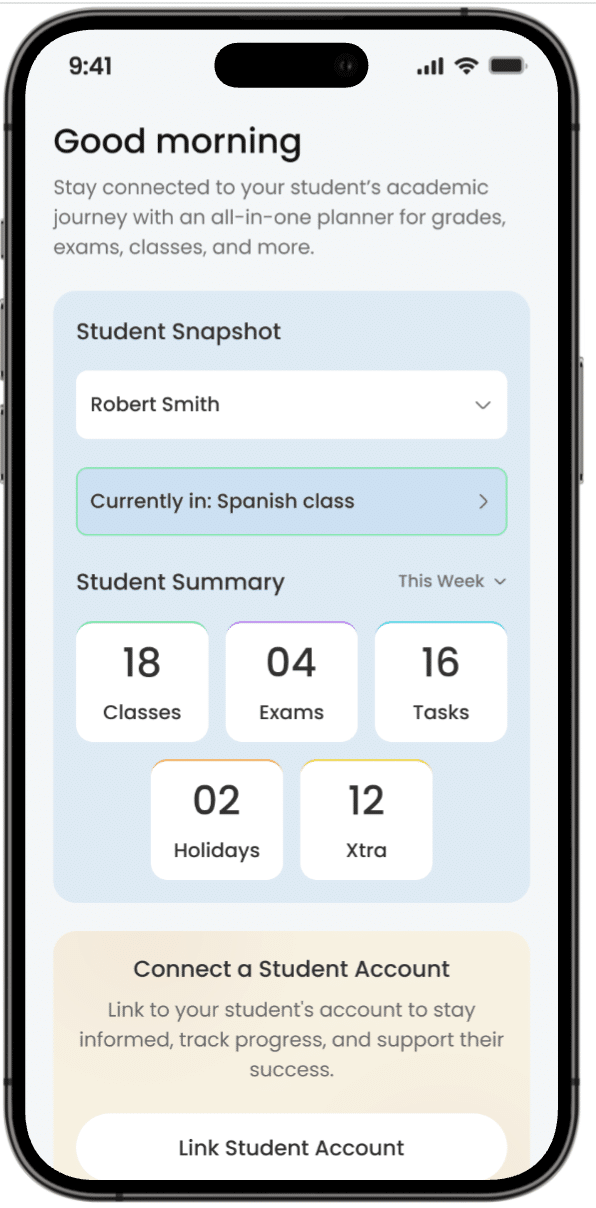
If you want visibility into your child’s schedule without having to ask every evening, MyStudyLife’s Family Connect gives parents a view of upcoming exams, tasks, and deadlines — without hovering over their shoulder.
If your child is anxious, resist the urge to minimise. “You’ll be fine” is well-intentioned but dismissive. A better response: “It makes sense that you’re stressed — exams are a lot. Let’s look at what’s left and figure out what to tackle first.” Acknowledge the feeling, then redirect toward action. Research from the Australian Institute of Family Studies supports this approach — children cope better when their emotions are validated before being redirected.
Teach Them How to Study, Not Just When
Many students confuse reading notes with actual revision. They highlight entire paragraphs in yellow and assume the information has somehow transferred to their brain. It hasn’t.
Two techniques consistently backed by cognitive science are active recall and spaced repetition. Active recall means testing yourself on material rather than passively re-reading it — think flashcards, practice questions, or simply closing the textbook and writing down everything you remember about a topic. Spaced repetition means reviewing material at increasing intervals rather than cramming everything the night before. A landmark review by Dunlosky et al. (2013) found that these two strategies are among the most effective study techniques available — and yet most students don’t use them.
You can support this at home. Offer to quiz your child. Ask them to explain a concept to you as if you know nothing about it — teaching is one of the most effective ways to consolidate learning. If they can explain it clearly, they know it. If they can’t, they’ve just identified exactly where they need to focus.
MyStudyLife’s revision task feature lets students create multiple revision sessions linked to a single exam, breaking preparation into manageable parts rather than one overwhelming block. For more hands-on strategies, our exam study tips guide covers techniques students can put into practice today.

Watch for Warning Signs
Some stress before exams is normal and even productive. But there’s a line between healthy nerves and something more concerning.
Watch for changes in sleep patterns, appetite, mood, or social withdrawal. A child who suddenly doesn’t want to go to school, who’s having stomach aches or headaches with no clear cause, or who seems emotionally flat may be dealing with more than standard exam anxiety. The Grattan Institute’s 2025 report on school attendance found that around 40% of Australian students miss at least one in every ten school days — a pattern that often accelerates during high-pressure assessment periods.
If you notice these signs, have a calm, private conversation. Don’t interrogate — just open the door. And if things don’t improve, reach out to your child’s teacher or school wellbeing team. You don’t have to wait until it’s a crisis. ReachOut Parents and Kids Helpline (1800 55 1800) are also excellent resources for families navigating exam-related stress.
Keep Perspective — and Help Them Keep It Too
Mid-year exams matter, but they’re not the end of the story. They’re a checkpoint, not a verdict. For most students, these results are formative — they show where the gaps are so there’s time to address them before the end of year.
Remind your child (and yourself) that one bad result doesn’t define their ability or their future. What matters more is what they learn about how they study, what works for them, and what they’d do differently next time. That metacognitive skill — understanding how you learn — is worth more in the long run than any individual mark.
If your child is open to building better planning habits beyond exam season, digital planners designed for students can be a low-friction way to start — especially when the tools are designed for their world rather than adapted from adult productivity apps.
A Quick Checklist for Parents
This week:
- Sit down together and list every exam date and subject
- Build a realistic study timetable with breaks and rest days
- Set up a distraction-free study space (phones in another room)
During the exam period:
- Keep meals consistent and nutritious
- Enforce reasonable bedtimes — sleep is non-negotiable
- Ask specific, low-pressure questions about their revision
- Offer to quiz them or listen while they explain a topic
After exams:
- Celebrate effort, not just grades
- Use results as a roadmap, not a report card
- Talk about what study strategies worked and what didn’t
Mid-year exams don’t have to be a household crisis. With a bit of structure, the right environment, and conversations that focus on progress rather than perfection, you can help your child build habits that carry them well beyond this exam period. MyStudyLife helps students plan their revision, track their tasks, and stay on top of their schedule — and Family Connect keeps parents in the loop without the nagging. Download it free on iOS and Android.


