


Here’s the thing everyone gets wrong about procrastination: it has almost nothing to do with time management. Students who procrastinate can usually tell you exactly what’s due and exactly how long it will take. They know. They still don’t start.
What’s actually happening is more like mood repair. The task makes you feel something unpleasant — boredom, confusion, the fear it won’t be good enough — and putting it off makes that feeling go away for a while. That’s why the reward is so immediate and the cost so delayed, and it’s why “just be more disciplined” has never worked for anyone.
If the problem is the feeling, the fix has to deal with the feeling.
Quick answer
– Procrastination is mood repair, not poor time management — the task makes you feel something and avoiding it helps.
– Name which feeling it is, then use the matching fix: a smaller first step, a fixed block, or an earlier slot.
– Forgiving yourself for last time measurably reduces the next one.
Find out what the feeling actually is
Two of these have their own fixes elsewhere: if the task is too vague, our guide to turning a syllabus into a semester plan breaks big work into stages with dates, and if it’s boredom, a 25-minute timer gives the session a floor and a ceiling.
Different flavours of avoidance need different fixes. Next time you catch yourself not starting, name it.
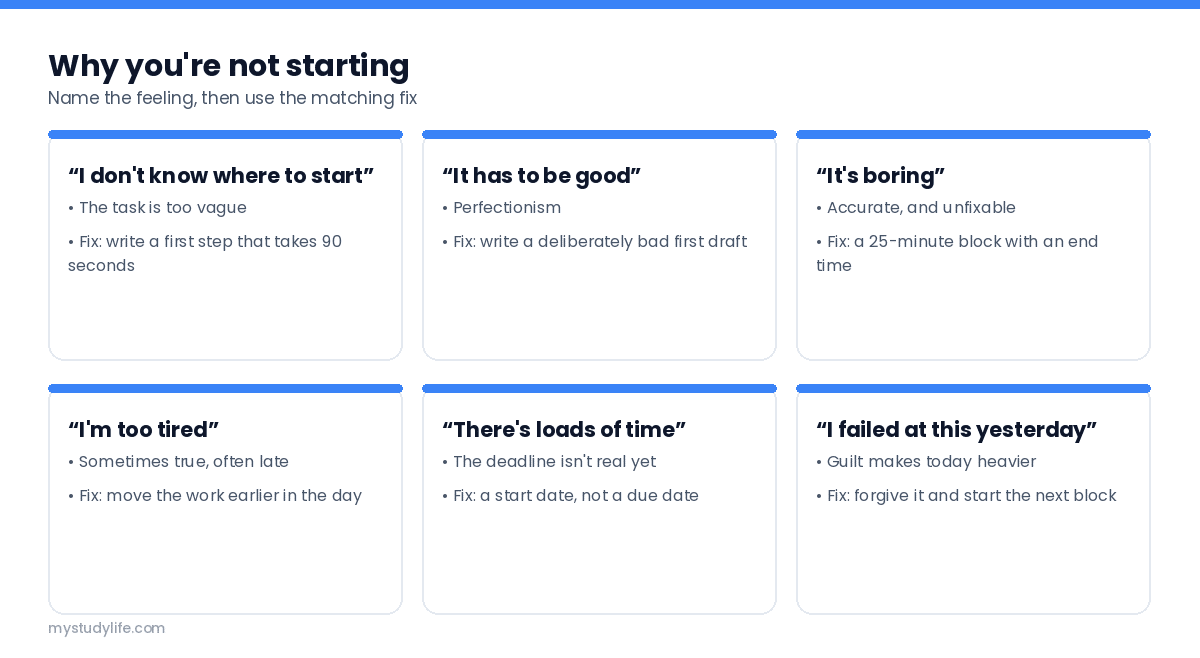
“I don’t know where to start.” The task is too vague. This is the most common one by far, and the easiest to fix.
“It has to be good.” Perfectionism. Not starting protects you from producing something bad, which feels safer than trying.
“It’s boring.” Fair. The work genuinely is boring, and nothing will make it interesting. This one needs structure, not motivation.
“I’m too tired.” Sometimes true. Often it’s 11pm and the real problem is that you left it until 11pm.
“There’s loads of time.” There isn’t, but the deadline is far enough away that it doesn’t feel real yet.
What actually helps
Two of these have proper evidence behind them. Producing an answer from memory beats reviewing it, and spacing the work beats massing it — the review of study techniques that established both is the closest thing this field has to a settled result. The timer trick has a name and a method: the Pomodoro Technique, which is worth reading in its original form before you download anything.
Starting is the hard part. Once you’re four minutes in, the aversion has usually gone.

Make the first step embarrassingly small
“Write essay” is not a task, it’s a project, and your brain treats it like one. “Open the document and write the question at the top” is a task. It takes ninety seconds and it’s almost impossible to argue with.
Starting is the hard part. Once you’re four minutes in, the aversion has usually gone, because the thing you were avoiding was starting, not working.
Use a fixed block, not a target
“Study until I’ve finished chapter 6” is open-ended, and open-ended is frightening. “25 minutes on chapter 6, then a break” has a floor and a ceiling. That’s the entire logic of the Pomodoro technique, and it works because it’s a commitment to time rather than to outcome.
Decide when and where, in advance
There’s good evidence that plans of the form “when X happens, I will do Y” beat general intentions. “I’ll study more this week” does nothing. “After my last class on Tuesday, I’ll go to the library and do question set 3” is a decision you’ve already made, so you don’t have to make it again when you’re tired.
Write those into a planner rather than your head. If every study block already has a time and a subject attached, the daily negotiation disappears.
Separate planning from doing
Planning feels productive and is not the same as work. Do it once a week — ten minutes on a Sunday, looking at what’s due — and then don’t revisit it. Rewriting your revision timetable is procrastination with good handwriting.
Handle the phone properly
Not face down. Another room, or a drawer. The research on this is unkind: the mere presence of a phone within reach costs attention even when it’s silent. Nobody is strong enough to ignore something that has spent five years training them to pick it up.
Forgive the last time
The strongest finding in this field is also the strangest. Students who forgave themselves for procrastinating before an exam procrastinated less before the next one. Guilt about having wasted yesterday makes today’s task heavier, so it gets avoided too. Skip the self-criticism and just start the next block.
A week to reset it

| Day | What to do |
|---|---|
| Sunday | Ten minutes: everything due in the next fortnight, into one planner |
| Monday | Pick your three worst tasks. Write the first tiny step for each |
| Tuesday | Two 25-minute blocks, phone in another room |
| Wednesday | Same, at the same time of day. You’re building the slot, not the habit |
| Thursday | Do the task you’ve avoided longest. Just the first step |
| Friday | Notice what got done. No audit, no guilt |
| Saturday | Off |
The point of the week is not to catch up on everything. It’s to prove to yourself that starting is survivable, which is the belief that procrastination erodes.
When it’s more than procrastination
If avoidance is constant across every part of life, comes with a lot of anxiety, or has been there for years, that’s worth talking to someone about rather than solving with a timer. School counsellors, student support services and GPs deal with this all the time, and ADHD and anxiety both produce something that looks like procrastination from the outside but doesn’t respond to the same fixes. Our guide to planners for students with ADHD covers approaches that assume less about willpower.
The tools that help, and the ones that don’t

Apps don’t fix avoidance, but two things make the fixes easier to keep up.
A single place where the work lives. Half of not-starting is not being sure what to start. If every deadline is in one planner, “what should I be doing right now” has an answer, and the answer arrives before the anxiety does. MyStudyLife does this free across your phone and laptop, with reminders that turn up before a block rather than after a deadline.
A timer. Any timer. The point is that it’s external — a decision you made ten minutes ago, rather than one you’re making now while tired.
What doesn’t help: blocking apps you can disable in two taps, elaborate productivity systems that need maintaining, and any technique that depends on wanting to work. You will not want to. That’s fine — the whole design brief is to make starting possible while not wanting to.
In short
Name the feeling, shrink the first step to ninety seconds, put the block in a planner with a time attached, and stop rewriting the plan. If avoidance is constant across everything rather than task-specific, that’s worth talking to someone about rather than solving with a timer.
FAQ
Why do I procrastinate on things I actually care about?
Because caring raises the stakes. The more the outcome matters, the more unpleasant the possibility of doing it badly, and the more attractive avoidance becomes. Perfectionism and procrastination are close relatives.
Does the Pomodoro technique really work?
For many people, yes, because it makes the commitment small and time-bound rather than open-ended. Twenty-five minutes is arbitrary — use whatever length you can start without arguing.
How do I stop procrastinating at night?
Move the work earlier. Late-night procrastination is usually a scheduling problem: the day filled up with everything else, and the hard task got the hours where you have the least left.
Is procrastination a sign of laziness?
No. Lazy people don’t feel bad about not working. The guilt that comes with procrastination is the giveaway that you want to do the thing.
What’s the quickest thing I can do right now?
Open the document and write one sentence. Not a good sentence. Then set a timer for fifteen minutes.


