
Summer exams in England, Wales and Northern Ireland run from early May to late June, and the exam boards publish provisional timetables well over a year ahead. For 2027, AQA, Pearson Edexcel, OCR and WJEC have all published their May/June timetables, so you can build a revision plan around real dates rather than guesswork.
Two things to know before you plan anything.
Your timetable is personal. The board timetable lists every paper for every subject. Yours is the subset you’re entered for, issued by your school, usually in the spring term. It’s the only one worth planning against.
Contingency days exist. Boards keep a contingency day at the end of the window in case something disrupts the session, so keep the last week of the window free even if your final listed paper is earlier.
Check your board directly: AQA’s dates and timetables page carries the confirmed May/June 2027 documents, and the other boards publish the equivalent.
Quick answer
– The summer 2027 window runs from early May to late June, and the boards have published provisional timetables.
– Your personal timetable, from school in the spring term, is the one to plan against.
– Keep the last week of the window free for the contingency day.
How the exam season is structured

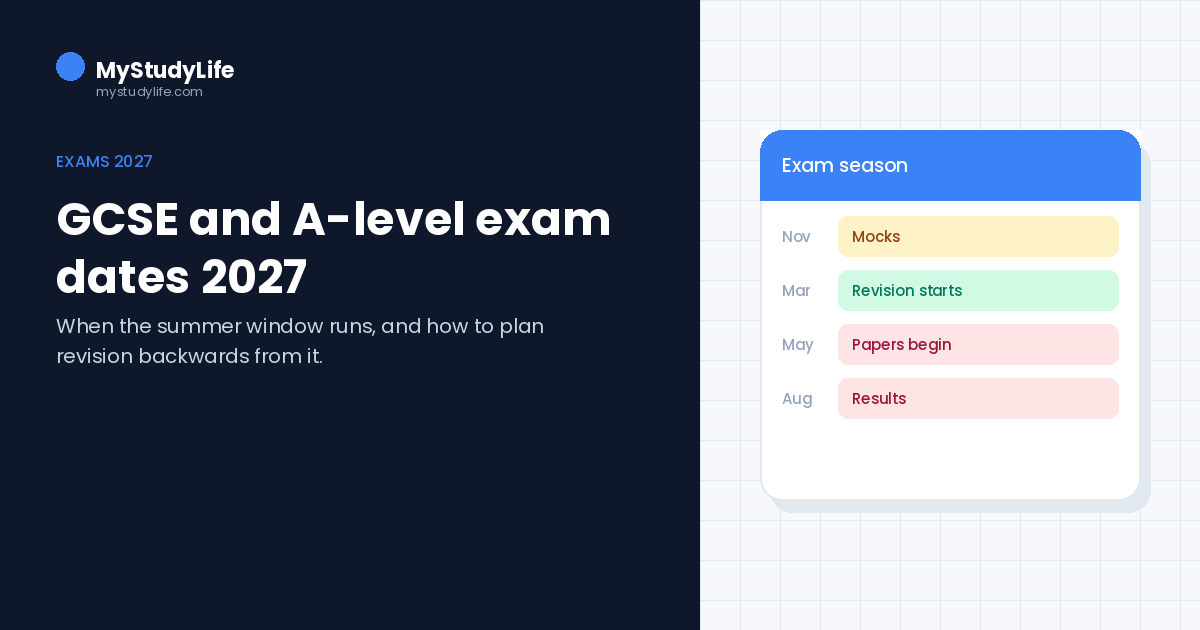
- Early May: the window opens. A-level papers often start before GCSEs.
- Mid May to early June: the densest stretch. Most core GCSE subjects sit here, and half term falls inside it.
- Mid June: the tail, including second and third papers in larger subjects.
- Late June: contingency day and the end of the window.
Results follow in August: A-levels first, GCSEs a week later.

Planning backwards from your dates

Once you have your personal timetable, the plan becomes arithmetic.
- Write every paper in order with its date, time and duration.
- Mark the gaps. Some subjects have papers days apart; others are separated by weeks. Late papers get revised during the exam period, which takes pressure off the spring.
- Count back six to eight weeks from your first paper. That’s when structured revision starts, which for a May exam is roughly March.
- Rate every topic red, amber or green using the specification, and spend your time on red.
- Book past papers into the calendar, not just topics. Timed, handwritten, marked against the mark scheme.
Our revision timetable guide covers the block-level detail and a template that survives a real week.
Between now and then
JCQ publishes the key dates for each series and AQA the full provisional timetables, with the other boards doing the same. Mocks are the rehearsal for all of this — our revision timetable guide covers the six-week shape, and the half-term plan covers the week before them.
Mocks are the useful rehearsal, and for most schools they’re in November, with a second round for some in the spring. Treat the mock timetable as a dry run for exactly this process: build a revision plan from real dates, discover what doesn’t work, and fix it while the stakes are low.
Keep both timetables — school and exam — in one place. MyStudyLife holds a rotating school timetable, your exams with dates, times and rooms, and revision blocks as tasks against each subject, so the countdown is visible rather than looming.
Key dates checklist
- Board timetable published — already available for summer 2027
- Personal timetable from school — usually spring term
- Structured revision starts — six to eight weeks before your first paper
- Study leave — school-dependent, typically from mid May
- Contingency day — end of the window, keep it free
- Results days — A-level in mid August, GCSE about a week later
What the dates mean for your year
Autumn term. Mocks, usually November for Year 11. Treat them as a rehearsal for the real planning process, not just the papers.
Spring term. Personal timetables arrive, coursework and NEA deadlines land, and structured revision starts six to eight weeks before the first paper — March for most students.
Study leave. School-dependent, typically from mid May. Some schools keep students in for timetabled revision sessions, which are usually worth more than an unstructured day at home.
The window itself. Seven weeks, with gaps between papers that vary enormously by subject combination. Those gaps are revision time for later subjects, which is why planning around your own timetable beats a generic plan.
Two dates people forget

You must stay available for the contingency day, even if your last listed paper is two weeks earlier.
The contingency day at the end of the window. You must remain available, even if your last listed paper is two weeks earlier.
Results days in August. A-level first, GCSE about a week later. If you’re applying through UCAS, results day is also the day offers are confirmed, so know your firm and insurance choices before it arrives.
Building the revision plan from the timetable
Work backwards from your own dates rather than from a generic six-week block — our revision timetable guide has the build, and the half term plan covers the week before mocks.
Once your personal timetable arrives, the plan is arithmetic rather than guesswork.
Write the papers in order, with dates and durations. Mark the gaps — a subject with papers on 12 May and 6 June has three weeks in the middle that belong to it, which changes how much it needs in March. Count back eight weeks from the first paper and put a start date in the calendar. Then rate every topic on every specification red, amber or green, and spend the first four weeks entirely on red.
Timed past papers belong in the last three weeks, handwritten, marked against the mark scheme. Everything before that is recall practice: blurting, flashcards, and questions by topic.
For parents
The most useful things a parent can do are unglamorous: know the dates, protect a quiet space and a routine, and keep the household calendar clear of anything big in the exam weeks. Beyond that, asking “what are you working on today” beats asking “have you revised”, which reliably gets a yes and tells you nothing.
If you’re sitting resits
November resits exist for English language and maths GCSE, with exams in the autumn term and results in the following January. If that’s you, the timetable to plan around is the autumn one rather than the summer window, and the run-up is shorter — six weeks from the start of term rather than a spring-long campaign.
The method is the same: specification, red-amber-green, past papers marked against the mark scheme. What changes is that you already know the paper, which means your miss list from the summer is the most valuable revision document you own.
In short
Get the board timetable now, your personal one in the spring, count back eight weeks, and rate every topic before you build a single block.
FAQ
When do GCSE exams start in 2027?
The summer window opens in early May and runs to late June. Exact subject dates are on your board’s May/June 2027 timetable, and your school issues your personal version.
When are A-level exams in 2027?
Within the same window, usually beginning a little earlier in May than GCSEs, with papers spread across the season.
What is the contingency day?
A reserved date at the end of the exam window, used only if an unforeseen national disruption forces a paper to be moved. Stay available for it.
When will I get my personal exam timetable?
Usually in the spring term, from your exams officer. Until then, plan from the board timetable for the subjects you’re entered for.
When are GCSE results day and A-level results day 2027?
August, with A-level results first and GCSE results about a week later. Exact dates are published by JCQ.
How early should I start revising?
Structured revision six to eight weeks out, and consistent weekly review from the start of the course. Cramming a two-year specification in a fortnight doesn’t work.