


Most parents don’t want to micromanage. They want visibility without conflict.
The problem is not homework. The problem is information asymmetry. When parents don’t know what’s due, reminders turn into interrogation. When children feel monitored instead of supported, resistance increases.
There is a way to track homework without damaging independence. The key is structure, transparency, and age-appropriate oversight.
This article breaks down the research and the practical system.

Why Nagging Backfires (What Research Says)
Developmental psychology consistently shows that autonomy-supportive parenting produces better academic outcomes than controlling approaches.
- Self-Determination Theory (Deci & Ryan) demonstrates that students perform better when they feel autonomy, competence, and relatedness — not pressure.
- Research published in the Journal of Educational Psychology shows that parental monitoring improves outcomes when it is structured and predictable, but harms motivation when it feels intrusive.
- Studies on executive function development (Center on the Developing Child, Harvard University) confirm that planning and time management skills mature gradually through adolescence — they are not automatic.
Translation: Children need structure. They do not need constant reminders.
The Real Solution: Visibility Without Control
Instead of asking, “Did you finish your homework?”
Shift to: “Let’s check the planner.”
The difference is emotional. One is accusatory. The other is neutral.
The system works best when:
- Homework lives in a single structured planner
- Parents can view it without demanding screenshots
- Check-ins are scheduled, not reactive
This is where shared student planner systems — like MyStudyLife Family Connect — become practical tools rather than control mechanisms.
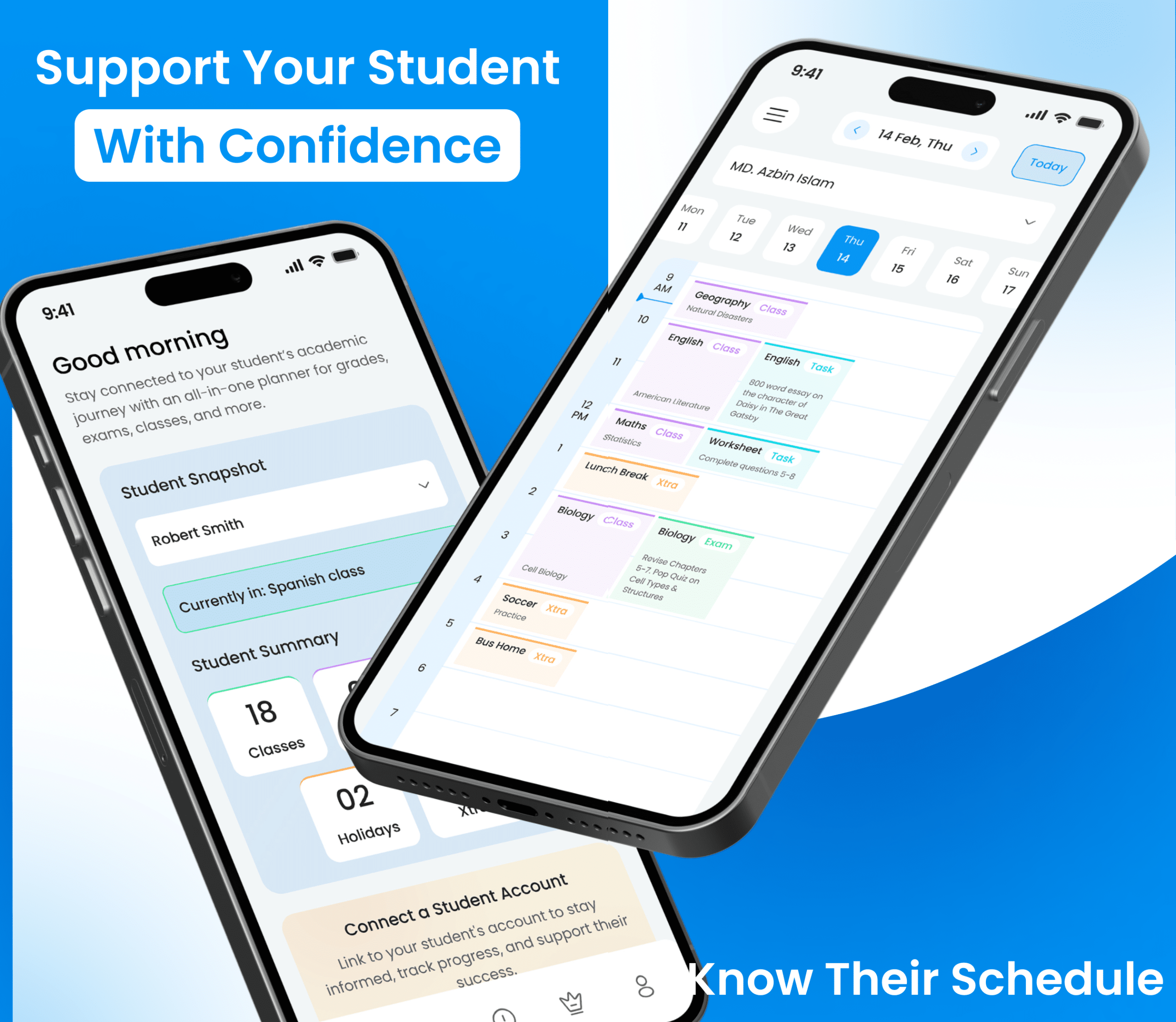
Family Connect allows a parent to link their account to their child’s student planner. Parents can see assignments, exams, and schedules without logging into the child’s account or disrupting their workflow.
That visibility reduces interrogation.
How to Monitor Homework by Age Group
Oversight should change as cognitive skills mature.
Ages 6–9 (Primary School)
Brain development stage: Executive function is still forming. Working memory and planning skills are limited.
What works:
- Daily 5-minute check-in
- Visual calendar or digital planner review
- Parent helps input assignments
What does not work:
- “You’re old enough to remember.”
- Expecting independent time blocking
At this stage, the parent is the system.
A shared digital planner lets the parent verify assignments without re-asking the teacher or child repeatedly.
Ages 10–13 (Middle School Transition)
This is the most fragile stage.
Homework increases. Teachers expect independence. Executive function is still inconsistent.
What works:
- Scheduled weekly review session (Sunday evening)
- Child inputs assignments themselves
- Parent reviews planner once per week
What does not work:
- Daily interrogation
- Random checks after missed deadlines
Research shows middle school is where organization failures spike. Structure should increase, not pressure.
Using a shared planner like Family Connect at this stage creates accountability without confrontation. The child knows the parent can see the assignments — but they aren’t being policed every night.
Ages 14–18 (High School)
Now autonomy becomes critical.
Teens who perceive parental control often show decreased intrinsic motivation (Self-Determination Theory).
What works:
- Agreement-based monitoring (“I’ll review once per week.”)
- Parent monitors major deadlines, not daily homework
- Focus on exams and long-term projects
What does not work:
- Daily micromanagement
- Taking over task completion
High school students benefit from reduced frequency, increased responsibility.
Family Connect supports this shift because it allows passive oversight. Parents can check in only when necessary.
How to Create Independence (Without Dropping the Safety Net)

Independence is not the removal of support. It is the gradual transfer of responsibility.
Use this progression model:
Step 1: Co-Ownership
Parent and child enter assignments together.
Step 2: Guided Ownership
Child enters tasks. Parent reviews weekly.
Step 3: Independent Ownership
Child manages fully. Parent checks only before exam periods.
The key is consistency.
Research in adolescent development shows that predictable structure increases self-regulation more effectively than variable enforcement.
Replace Nagging With Systems
Nagging is reactive. Systems are proactive.
Instead of:
- “Did you do your math?”
- “Why didn’t you tell me about the test?”
Shift to:
- “Let’s check the planner.”
- “What’s coming up this week?”
When homework lives inside a shared student planner:
- No memory battles
- No “you never told me”
- No late-night surprises
Why Shared Visibility Reduces Conflict
Family systems research shows conflict increases when expectations are unclear.
A shared academic dashboard:
- Aligns expectations
- Reduces emotional escalation
- Makes performance data neutral
Family Connect works because it separates access from control and visibility from interference.
Parents see the schedule. Students keep ownership of their workflow.
Practical Weekly Structure (Low Conflict Model)
If you want a framework:
Sunday:
- 10-minute review of upcoming week
- Discuss major deadlines
- No lecturing
Midweek (optional for younger students):
- 5-minute quick glance
- Focus on upcoming exams
No daily questioning. Consistency beats intensity.
Common Mistakes Parents Make
- Checking only after grades drop
- Monitoring inconsistently
- Using planner checks as a disciplinary tool
- Removing autonomy too quickly
Monitoring should feel procedural, not punitive.
Is a Homework Tracker App Necessary?
Technically, no.
But digital systems outperform paper planners in:
- Real-time updates
- Multi-device access
- Parent visibility
- Exam reminders
A shared digital student planner — especially one designed for academic scheduling — removes friction.
MyStudyLife’s Family Connect feature exists specifically for this use case: parent oversight without account sharing or password access.
Final Framework
If you want to track homework without nagging:
- Put everything in one structured planner
- Schedule review times
- Adjust oversight by age
- Separate visibility from control
- Gradually transfer responsibility
Homework conflict is rarely about homework.
It’s about uncertainty, missed expectations, and executive function still under construction.
Build a system. Then let it run.


